
Contemporary workplaces, especially in India, are witnessing unprecedented dynamism in learning culture. The Freudian concepts of the id, ego, and superego, while subject to contemporary psychological criticism, can still offer a relevant framework for understanding psychological growth, development, and learning behaviour within today’s working culture. Amid digital transformation, hybrid teams, and generational diversity, the psychoanalytic constructs of id, ego, and superego, introduced by Sigmund Freud, offer a compelling lens to understand workplace behaviour and psychological growth
Freud’s Structural Model
Sigmund Freud’s structural model of the psyche divides the personality into three interacting components: the id, ego, and superego. Here’s how his concepts can be applied:
The id, representing primal urges and desires, can be linked to an individual’s intrinsic motivation to learn and seek immediate gratification. When a learning task resonates with an individual’s innate curiosity or desire for mastery, it taps into this deeper drive for gratification, leading to a more engaged and effective learning experience.
Example: An employee passionately invested in a particular skill or subject may exhibit a strong “id-driven” desire to learn more, driving self-directed learning and proactive engagement with new information.
The ego, responsible for the rational mediator operating under the reality principle, mediates between desires and reality, and relates to a learner’s ability to adapt and strategise. Individuals with a stronger ego may be better equipped to develop and implement effective learning strategies, balance the demands of work and learning, and overcome obstacles or challenges encountered during the learning process.
Example: An employee facing a tight deadline while simultaneously needing to learn a new software program would rely on their ego to prioritise tasks, seek necessary support, and manage time effectively to achieve both work and learning goals.
The superego, representing internalised moral standards serving as the conscience of societal values, connects to an individual’s adherence to ethical workplace conduct and professional standards during the learning and development process. Learners with a strong superego are more likely to internalise and uphold principles of academic integrity, avoid plagiarism and shortcuts, and strive for ethical, high-quality outcomes in their learning endeavours.
Example: An employee tasked with developing a new compliance training module will draw upon their superego to ensure the information is accurate, ethical, and adheres to all regulatory guidelines.
One of the most common yet sensitive moments in any workplace, particularly in feedback-driven learning environments, is how professionals respond to criticism.
Understanding this through Freud’s framework reveals not only inner conflict but also growth potential:
The Id Reaction:
“I’m upset and want to snap back immediately because they hurt my feelings.” This reflects our raw emotional instinct, the need to defend our self-worth, retaliate, or withdraw. In many high-pressure Indian work environments, especially where hierarchical feedback is common, this response can be intense, particularly among younger employees (Gen Z) who expect more collaborative communication.
The Superego Reaction:
“I should remain calm and composed, taking criticism professionally and not personally.” Here, the individual responds based on internalised values and cultural conditioning, to appear respectful, mature, and ‘ideal’. In India’s corporate culture, where respect for authority and saving face is emphasised, this is often the expected default. However, it may suppress real feelings, leading to internal conflict.
The Ego Response (Ideal Learning Behaviour):
“I’ll consider the feedback, see if there’s any truth to it, and respond diplomatically, asking for clarification if needed.” This is the healthy integration of both emotion and reason, acknowledging discomfort but responding constructively. It reflects psychological maturity, self-regulation, and openness to growth, traits increasingly valued in modern Indian organisations that are shifting from authority-based to feedback-rich cultures.
Why This Matters in L&D
For Gen Z: Help them recognise and regulate emotional triggers (id).
For Gen Y: Empower them to balance ambition and feedback without over-deferring to authority (ego).
For Gen X: Encourage authentic but composed responses rather than masking under-duty-bound superego filters.
Through this lens, reaction to criticism becomes a teachable moment, not just a behavioural outcome. L&D programs can incorporate simulated feedback scenarios, reflective journaling, and AI-powered emotional-response training to develop this balance among professionals at every level.
1. The Id: The Drive for Immediate Solutions
Indian professionals often face high-pressure environments that require rapid problem-solving. The id’s instinctive urge for quick results manifests as employees favouring immediate access to knowledge over structured training, mirroring the rise of just-in-time learning, especially among younger professionals.
2. The Ego: Balancing Ambition with Organisational Realities
Effective learners in India exercise ego strength by aligning ambition with practical constraints, resource limitations, hierarchy, and compliance. This reflects the ego’s role in delaying gratification and navigating social norms (reality principle)
3. The Superego: Cultural Norms & Ethical Frameworks
India’s strong emphasis on respect, duty, and ethical behaviour correlates with the superego’s internalised moral standards. Learning programs incorporating values-aligned case studies, e.g., honours for “integrity in leadership”, resonate deeply due to this moral backbone.
Why This Framework Matters Today
While empirical research on Freud’s constructs is limited, recent advances reaffirm their conceptual relevance:
A 2025 educational review highlighted how Freud’s model enriches understanding of emotional development and learning motivation, helping shape learner-centric education in India.
Studies in cross-cultural psychology suggest that psychoanalytic insights hold in Asian contexts, given the adaptability of defence mechanisms across cultures.
The Reality Principle, central to ego functioning, is foundational to self-regulation and delayed gratification—traits tied to job performance and learning adaptability.
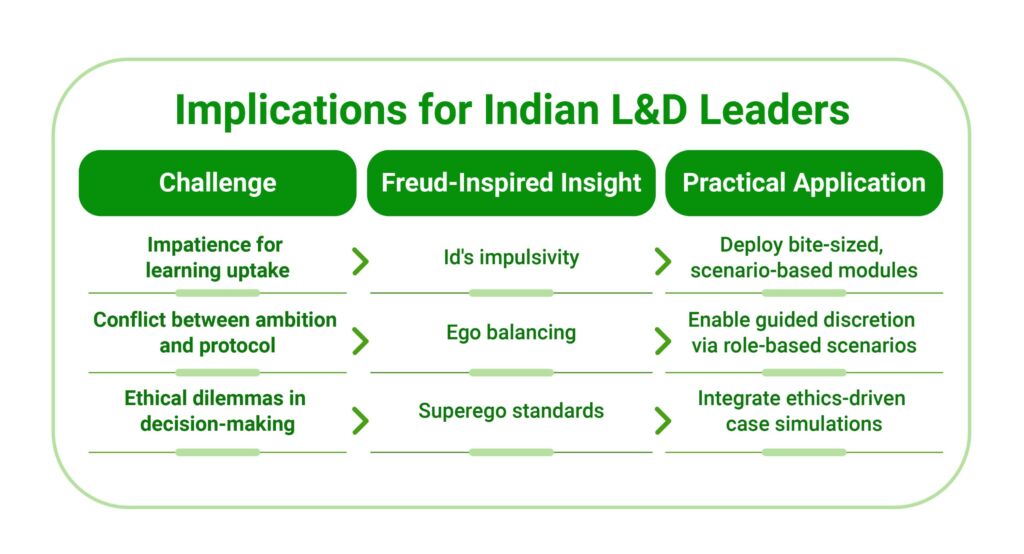
Implications for Indian L&D Leaders
A mature learning ecosystem, inspired by Freud, is where the id’s energy is channelled through the ego’s strategies and aligned with superego values.
Freud’s tripartite model invites us to consider learning behaviour as a psycho-social construct, not just cognitive mechanics. In India’s diverse workplace culture, understanding how impulses, rational alignment, and moral frameworks interplay illuminates how professionals grow psychologically, not just skill-wise.
As L&D designers, integrating modules that respect these psychic dynamics can foster deeper learning, resilience, and ethical acumen across Gen X, Y, and Z employees.
Let’s now explore how to weave Freud’s Id, Ego, and Superego insights into actual course designs and leadership training, especially tailored for the Indian corporate environment and its multi-generational workforce (Gen X, Y, Z).
To build emotionally intelligent, self-aware, and ethically aligned professionals by embedding psychodynamic understanding into L&D and leadership design, without making it feel academic or abstract.
1. Module Theme: Understanding the Self in the Workplace
Focus: Create awareness of inner drives, motivations, and ethical boundaries.
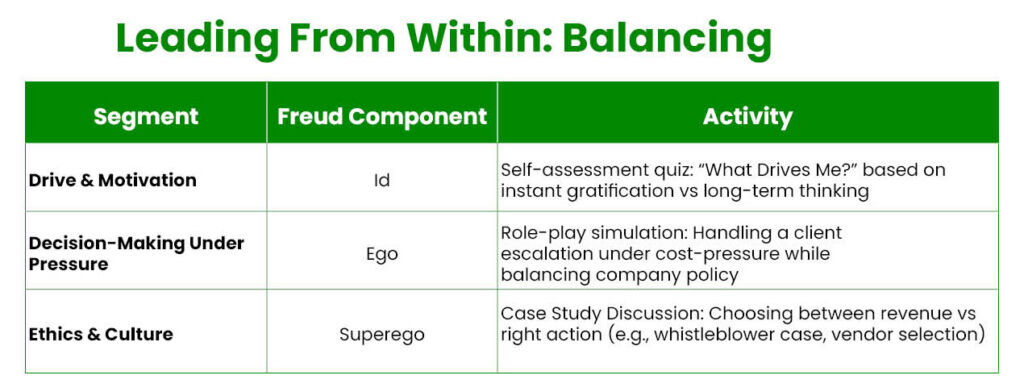
Course Title: Leading From Within: Balancing Drive, Discipline & Values”
2. Learning Pathways: Personalised by Generation
Gen X (40s–50s):
Tends toward Superego: Strong sense of duty, ethical clarity.
Design Tips:
- Include modules on mentorship and navigating grey zones in decision-making.
- Highlight legacy-building and value-based leadership.
Gen Y / Millennials (30s–40s):
Balanced Ego-Id dynamics: Ambitious yet self-regulated.
Design Tips:
- Use gamified modules with trade-off decisions.
- Create AI-powered simulations for real-world pressure testing (e.g., sales + ethics).
Gen Z (20s–30s):
Leaning toward Id: Desire for rapid progress and rewards.
Design Tips:
- Microlearning formats: Interactive stories, bite-sized “What would you do?” choices.
- Reflective tools to develop ego strength, self-regulation, delayed gratification, emotional control.
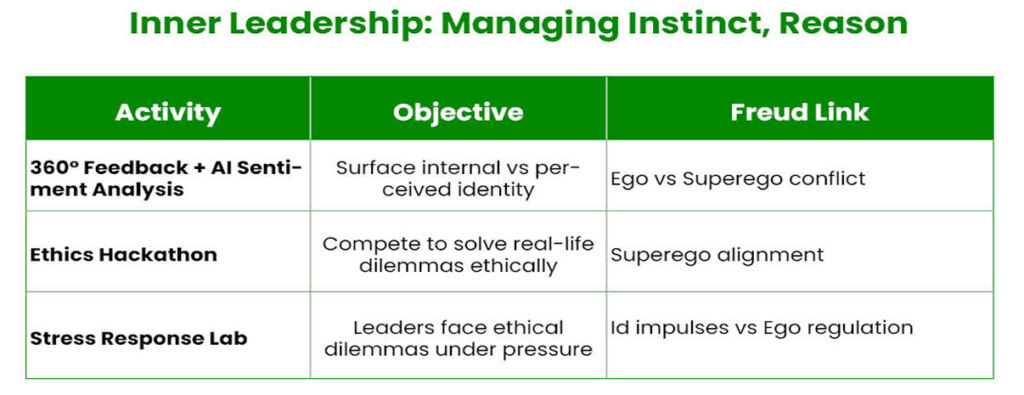
3. Leadership Training Labs: Applied Freudian Framework
Program Title: Inner Leadership: Managing Instinct, Reason & Integrity
4. Tools to Integrate
Psychometric Tools: Integrate soft Freudian elements into DISC or MBTI interpretations, e.g., How your ‘Type’ may respond to moral vs emotional conflict.
AI Coaching Platforms: Embed reflection prompts that tap into the three layers:
- What did you want to do instinctively (Id)?
- What were the practical limits (Ego)?
- What did your conscience tell you (Superego)?
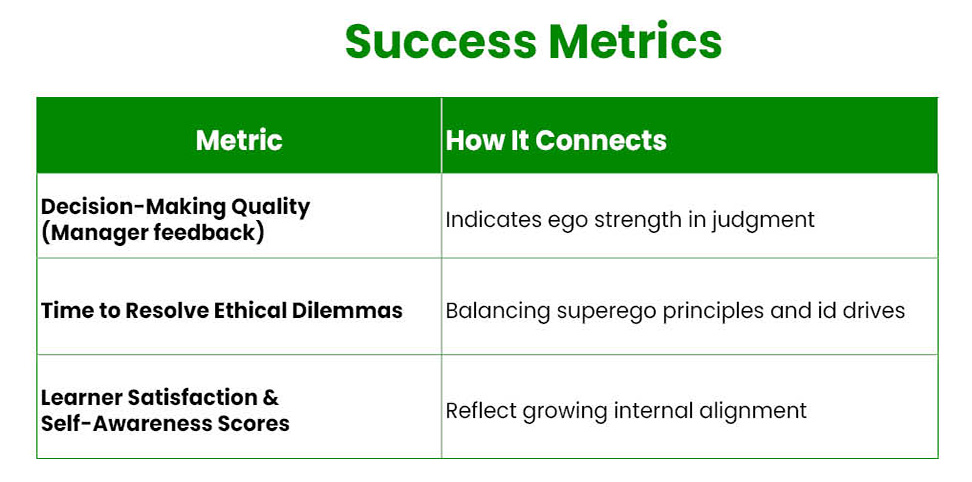
5. Success Metrics
To justify integration into mainstream L&D, some of the examples connecting it are;
This article explores how Sigmund Freud’s foundational psychological model: Id, Ego, and Superego, remains relevant in understanding learning behaviour, psychological development, and decision-making in today’s Indian workplace.
Using real-world corporate examples, it connects:
The Id to intrinsic motivation and instant gratification in self-driven learning
The Ego to adaptive learning strategies and balancing professional demands
The Superego to ethical standards, workplace values, and integrity in development
It also addresses how internal psychological conflicts between impulse and duty impact choices around learning, feedback, and professional growth.
Through this article, I am advocating for integrating these concepts into leadership training, L&D design, and behavioural development programs, especially for India’s diverse, multigenerational workforce.
Ultimately, it positions Freudian psychology as a timeless lens to build emotionally intelligent, ethically grounded, and self-aware professionals in the modern business landscape.
Read more: Reimagining Freud in Modern Indian Workplaces: The Id, Ego & Superego in Learning Behaviour